Showing posts with label IAATO. Show all posts

Monday, 18 March 2024

The ecological crisis no one is talking about

#expeditioncruising .


Unless you’ve you been tuning in to some of the more erudite media channels, you probably have no idea about the crisis unfolding in polar and sub-polar regions. The cruise companies certainly are not talking about it.

Tuesday, 1 May 2018

IAATO reports latest Antarctic visitor figures

#expeditioncruising .


The International Association of Antarctica Tour Operators (IAATO) reported its visitor numbers for the 2017-2018 Antarctic season at the start of its annual meeting in Newport, Rhode Island, USA.

Monday, 4 December 2017

IAATO launches 'One Stop' app for Antarctic field staff and visitors


The launch of the new IAATO Polar Guide: Antarctica app makes it quick and easy for Antarctic staff and visitors to access essential information while in the field.                 

To mark Antarctica Day (1 Dec), the International Association of Antarctica Tour Operators (IAATO) has launched a free iOS and Android app for staff guiding visitors in Antarctica that makes it quick and easy for users on-the-go in the field to access essential information, without the need for a phone signal.

IAATO, a member organisation formed in 1991 to advocate and promote the practice of safe and environmentally responsible private-sector travel to the Antarctic, developed the new Polar Guide: Antarctica app to include existing operational procedures and guidelines for wildlife watching, visiting specific sites, being a responsible Antarctic visitor, preventing the introduction of alien species and more. The app is also intended to be a useful resource for anyone visiting or keen to learn more about Antarctica, the Antarctic Treaty and the work being done to preserve the continent's extraordinary landscape and wildlife.

"The new IAATO Polar Guide: Antarctica app is the perfect support tool for IAATO staff in the field." said Lisa Kelley, IAATO Head of Operations. "Users can quickly refer to essential information in order to meet all IAATO and Antarctic Treaty System requirements for safe and ethical operations on and around the white continent.

"Given the importance of the Antarctic Treaty System for IAATO's mission of environmentally responsible travel and as a shining example of peaceful international collaboration, it seemed fitting to launch the app on Antarctica Day, which celebrates the signing of the Antarctic Treaty 58 years ago. "

IAATO members work together to develop, adopt and implement operational standards that mitigate potential environmental impacts.

The app will allow users to stay up to speed with the latest IAATO vessel and International Maritime Organisation (IMO) information for effective yacht and ship operations; and enable them to support Antarctic science and conservation while enhancing their experience in Antarctica by checking out selected citizen science projects.

Lisa added: "Antarctic travel, like other sectors, has changed and grown considerably over the last two decades. Our members are continuously researching new technology to strengthen our policy of safe and responsible travel while always abiding by Antarctic Treaty requirements.

"By using the IAATO Polar Guide: Antarctica App, you can feel confident that you are doing your utmost to protect Antarctica's great wilderness; a cause IAATO members have dedicated themselves to since the organisation's inception."

IAATO Polar Guide:  Antarctica can be downloaded now for iOS and Android.
                                                                       
Issued by the International Association of Antarctica Tour Operators.

Sunday, 10 July 2016

Antarctic tourism industry under pressure

#expeditioncruising


On 29 June, the International Association of Antarctica Tour Operators (IAATO) held their equivalent to the annual US football or basketball draft...attempting to secure their cruise ship landing schedules for the "top" Antarctic tourist destinations...Deception Island, Port Lockroy, Palmer Station...in an effort to insure that all of the cruise ship passengers had a unique Antarctic experience (eg not seeing any other cruise ships on their voyage). Fortunately I had an opportunity to visit/transit many of the great places along the Antarctic Peninsula during early or late austral summer when the cruise ships weren't around...and as I was working in the US Antarctic Program I was getting paid to do so! Anyway, here's the Guardian's take on this (the article took me a bit aback by the mention of "football" as played in the US rather than in the UK). https://www.theguardian.com/world/2016/jun/26/antarctica-tourism-regulations-cruises-field-trips

Monday, 22 February 2016

Opportunities and challenges revealed in new Antarctic tourism study

#expeditioncruising

New Study Reveals Patterns in Antarctic Tourism

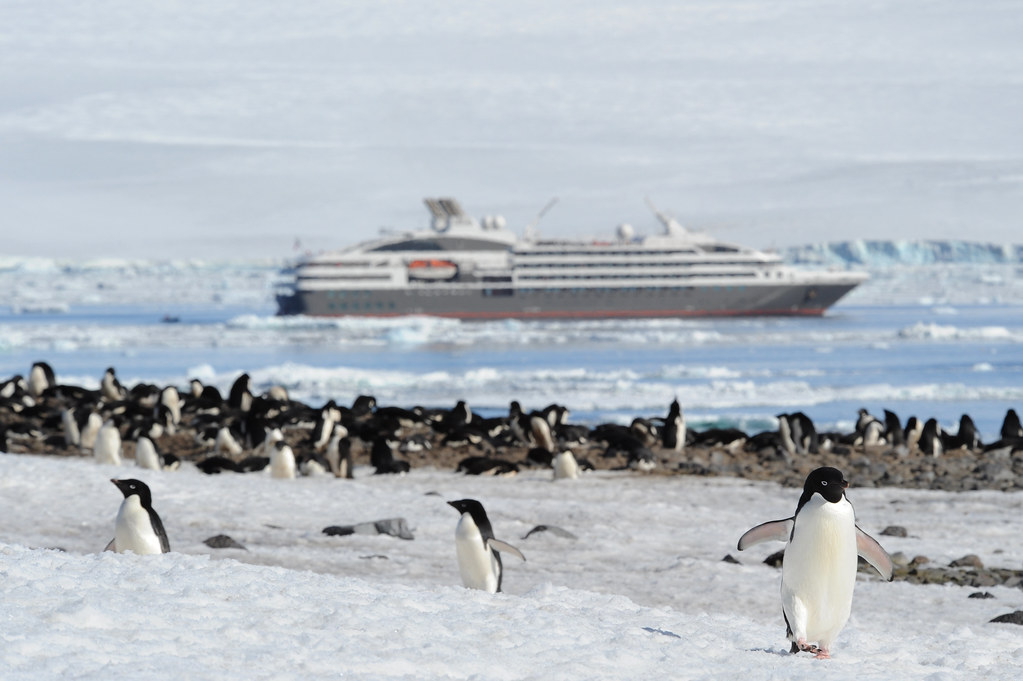
Ponant vessel in Antarctica, exemplifying the new era of luxury Antarctic cruising
Newport, Rhode Island, USA: Results from a new study examining 20 years of commercial cruise activity in the Antarctic Peninsula region have important implications for Antarctic visitor management. The paper was published online this week in the journal Antarctic Science.

The analysis was conducted by Stony Brook University, Stony Brook, New York in conjunction with the International Association of Antarctica Tour Operators (IAATO), which has developed the most comprehensive dataset of any human activity in the Antarctic as part of its mission to promote the practice of safe and environmentally responsible private sector travel to the continent. The study revealed that, while the overall number of visitors landed in the region has increased over the last two decades, tourism activity is highly concentrated at a few specific locations along the Peninsula’s south-western coast. In the 2012/2013 season for example, over 75% of all landings occurred on an area of land equating to less than one-sixth of the area of London’s Heathrow Airport, about 200 hectares.

Port Lockroy on the Antarctic Peninsula is one of the most visited sites (R Eime)
‘There are both opportunities and challenges to having concentrated landings of passengers at relatively few sites” says co-author Dr. Kim Crosbie, Executive Director of IAATO. “While this focus on a few sites, can create some challenges in terms of maintaining wilderness standards, it provides good opportunities for site-specific visitor management practices. As yet there has been little or no discernable impact at these sites, but understanding tourism patterns and trends is critical to reviewing management techniques for their continued protection.”

Antarctic tourism activity is also closely linked to economic activity in countries contributing the largest number of visitors. Nationalities have changed over time with China now representing 9% of all passengers visiting the Antarctic behind countries such as the USA, Australia and the UK. The growing market in Asia is expected to contribute to an increased demand to visit Antarctica in the coming years.

Lead author, Nicole Bender from Stony Brook University says, “Antarctica, though seemingly isolated, is strongly influenced by global socioeconomic forces. Understanding how these and also environmental drivers influence tourism patterns is hugely useful for informing management decisions regarding human activities in Antarctica.”


Thursday, 24 September 2015

Polar Tour Operators Hold First Antarctic/Arctic Field Guide Conference

#expeditioncruising

The poles are combining forces in Toronto next week at a unique conference for polar field staff organized by the International Association of Antarctica Tour Operators (IAATO) in collaboration with its sister organization in the Arctic, the Association of Arctic Expedition Cruise Operators (AECO).

The conference, which runs from 27-29 September, will provide a lively and interactive forum for sharing knowledge and best practice in polar guiding.

This is the first time that a field staff conference has focused on the challenges facing staff and member operators working in both Antarctica and the Arctic. Around the central mission of practicing safe and environmentally responsible travel in both regions, the agenda will focus on education, operational procedures, safety and risk management, conservation, heritage, communications and science support.

Susan Adie, Chair of IAATO’s Field Operations Committee and Expedition Operations Manager for Toronto based, G Adventures said, ‘Field staff are at the front line of our polar operations so not only are they often the first to identify issues, opportunities and future challenges, but can offer potential solutions to those as well. The outcomes from a conference like this will benefit the industry tremendously across all sectors.’

The series of talks and workshops has also attracted representatives from other organizations who work closely with AECO and IAATO including government agencies, science institutes and conservation organizations such as the WWF, Environment Canada, the Antarctic Southern Ocean Coalition and the UK Antarctic Heritage Trust. IAATO and AECO’s current contributions to citizen science will be presented and future collaborations discussed.

Bill Davis, AECO Executive Committee member and VP Operations for Quark Expeditions said, ‘In addition to covering the day to day opportunities and challenges of running of polar operations, the conference will also focus on how tourism is part of a wider global solution to protecting these great wildernesses for future generations.’

(IAATO) (AECO)


Monday, 5 January 2015

No aliens in Antarctica please: IAATO

#expeditioncruising


The International Association of Antarctica Tour Operators (IAATO) is offering guidance to all potential visitors on how to avoid accidently introducing alien species and external diseases to the unique Antarctic environment.

Over a decade ago IAATO recognized that the threat of introducing alien (non-native) species and pathogens could be elevated with increased human activity in Antarctica. They pioneered research into understanding the risks and developed effective procedures and guidelines for all visitors, not just tourists.

IAATO Executive Director, Dr Kim Crosbie, says, “Although there is no conclusive evidence that visitors have introduced alien species or external diseases, IAATO has long been concerned about the potential for visitors to be vectors. As part of our mission to conduct environmentally responsible travel, for several years we’ve worked with the science community to understand the risks better and develop procedures and guidance for anyone visiting Antarctica.”

Guidance for visitors includes:

• Before you go: The guidance is simple – take it new or take it clean. ‘Don’t Pack a Pest’  pre-departure information explains how and why all equipment, boots and clothing should be cleaned, vacuumed and disinfected before you head south.

• In Antarctica: Equipment, boots and clothing should be cleaned, disinfected and dried between each visitor site and between regions. IAATO operators, have biosecurity procedures in place for their clients, for example, if travelling by ship or yacht, wash stations are set up for use by everyone before and after landings. These stations use an IAATO approved biocide. To find out what is involved see http://iaato.org/decontamination-guidelines

• Remaining vigilant: All visitors are asked to report any suspicious looking organisms and or signs for invasive species. Additionally, IAATO also has a response package in place should a high wildlife mortality event be discovered to ensure a fast response and prevention of any spread of disease.

Tuesday, 23 December 2014

Drones to be banned in Antarctica?

#expeditioncruising


Travellers have been advised to check before flying a drone in Antarctica.

The International Association of Antarctica Tour Operators (IAATO) warns security measures essential for this relatively new activity. Tour operators may have to ban the use of unmanned vehicles out of environmental concerns.

IAATO is cautioning all potential travellers to Antarctica, who are hoping to fly a drone, or Unmanned Aerial Vehicle (UAV), to check with their travel agent or tour operator before packing their device.

Opportunities may be limited until more is known about their safe and environmentally responsible use in this last great wilderness - particularly in the wildlife rich coastal regions of Antarctica. Tour operators will either prohibit the use of UAVs altogether or only allow them to be operated under strictly defined conditions.

Both Antarctic Treaty Parties and IAATO members are concerned about UAVs in Antarctica; flying these devices is a relatively new activity.

While there are situations when UAVs might be useful, for science or ice reconnaissance for example, there are many questions still be answered about their use in terms of meeting IAATO's agreement that all their activities must be safe and environmentally responsible.


Within the Antarctic Treaty System, the unique global partnership that designates the entire continent as a natural reserve, all human activities, whether for science or tourism, have to go through an annual Environmental Impact Assessment by a relevant Competent Authority/government agency.

Planned activities that meet all relevant safety and environmental criteria are authorised and a permit granted. Using a UAV is considered a specific activity so has to be included in overall permit applications for assessment.

IAATO Executive Director, Dr. Kim Crosbie said, "Antarctica is still pristine with wildlife and landscapes that show little evidence of impact from direct human activity. To visit and operate in an environment like this comes with a responsibility to do so carefully and with minimal disturbance.

"The use of UAVs is in a state of development and, until more information is available, IAATO Member Operators and Competent Authorities are taking a precautionary approach when it comes to their operation.

The idea is to devise a pragmatic policy framework that will allow safe and environmentally responsible use under controlled circumstances." IAATO has been requested, on a consultancy basis, to present draft UAV guidelines and experiences at the next annual Antarctic Treaty Consultancy Meeting (ATCM) in Bulgaria, June 2015.

Saturday, 15 February 2014

Polar Pioneer distress call part of IAATO exercise

file image of Aurora Expeditions' Polar Pioneer (R Eime)

The International Association of Antarctica Tour Operators (IAATO) and two IAATO Member Operators, Aurora Expeditions and Oceanwide Expeditions, took part in a live search and rescue communications exercise in collaboration with the Maritime Rescue Coordination Center (MRCC) Ushuaia, Argentina.

The intent of the training exercise was to test the lines of communication between the ship in distress, MRCC Ushuaia and a vessel tasked with going to the incident area to assist.

In the scenario, the Polar Pioneer operated by Aurora Expeditions, sent out a distress call from the South Shetland Islands off the Antarctic Peninsula after losing propulsion due to its propeller being entangled in a fishing net. The ship was carrying 64 passengers and 26 crew. In response, MRCC Ushuaia identified Oceanwide Expeditions’ 116-passenger ship Plancius as being the nearest vessel and tasked it with going to assist.

IAATO Executive Director Dr. Kim Crosbie said “Search and rescue response in Antarctica is always a collaborative effort and we have a strong relationship with the five maritime rescue coordination centers that have responsibility in Antarctica. Live exercises such as this one provide valuable training opportunities, strengthen ties and demonstrate our ability to communicate in remote locations.

“Although we hope that these events are rare, IAATO’s role in collaboration with its member operators and the MRCCs is to ensure that we are ready to assist in any response quickly and effectively if they do occur.”

Friday, 20 April 2012

IAATO increasingly concerned on recent yacht related incidents in Antarctic waters

The Brazilian motor yacht ‘Mar Sem Fim’
crushed by ice on April 7 in Maxwell Bay,
South Shetland Islands.

Recent incidents and sightings involving yachts in Antarctic waters have generated considerable interest and concern among the members of the International Association of Antarctica Tour Operators (IAATO).

The incidents and reports – some of which have been covered by the media – involve commercial and private yachts not associated in any way with IAATO, according to Administrative Director Steve Wellmeier. Some of the incidents include:

The sinking of the Brazilian motor yacht ‘Mar Sem Fim’ April 7 in Maxwell Bay, South Shetland Islands. The four Brazilian passengers and crew were rescued unharmed by the Chilean Navy and transported by air from the nearby Presidente Eduardo Frei airstrip to Punta Arenas, Chile. The suspected cause of the sinking was compression of ice following severe weather the day earlier.

Read full story


Monday, 21 November 2011

Heavy Fuel Oil (HFO) in Antarctica Clarification


IAATO today issued a clarification on an IMO regulation that came into force earlier this year banning the use and carriage of heavy fuel oil (HFO) in the Antarctic Treaty Area and how its members are dealing with the ban.

“IAATO and its members have received calls from prospective Antarctic travelers and from the media confused about the HFO ban,” said Steve Wellmeier, executive director of IAATO. “There is some misunderstanding on the extent of the ban’s impact on Antarctica-bound cruise vessels, particularly the larger passenger vessels that generally use fuels defined as HFO.”

Media outlets have erroneously reported, for example, that large ships are banned altogether from operating in Antarctic waters as a result of the amendment to Annex 1 of the IMO MARPOL Convention, which came into effect August 1, 2011. This is not the case at all, according to Wellmeier. The ban prohibits the use and carriage of such fuels, and requires that ships traveling in the area – whether passenger or cargo ships – use and carry only lighter grade distillate fuels. Only vessels that are engaged in securing the safety of ships or in search-and-rescue operations are exempt.

“IAATO members who are operating large cruise ships to Antarctica are fully complying with the new regulation. Three Holland America Line vessels and one Azamara Club Cruise vessel plan cruise-only voyages to the Antarctic Peninsula this season,” he added. During the previous 2010-11 season, IAATO members operated a total of seven cruise-only vessels to Antarctica. Cruise-only vessels are defined by IAATO as those carrying more than 500 passengers, with no opportunities for shore landings in Antarctica.

Smaller expedition and mid-size vessels – those carrying 500 or fewer passengers – that are currently operated by IAATO members are not affected by the fuel ban, as they use and carry lighter distillate fuels such as marine gas oil or marine diesel oil.

A complete listing of IAATO members and vessels can be found in the membership directory and vessel directory of the IAATO website: www.iaato.org.


IAATO Launches New Website


The International Association of Antarctica Tour Operators (IAATO) has launched a new website, providing a wealth of new information for prospective travelers to Antarctica. The new site also features an expanded Media Center for journalists and enhanced features for IAATO members.

“The familiar URL www.iaato.org remains the same, but the similarity stops there,” noted IAATO Executive Director Steve Wellmeier. “The new site provides much better graphics and navigation tools, including a search function and site map. One of our goals is to provide accurate information for the Antarctic traveler, particularly in the area of environmental stewardship, guidelines for visitors, and answers to the many questions they might have.”


Tuesday, 10 May 2011

Declining Tourism Numbers in Antarctica


No more big ships in Antarctica. Thin skin and thick oil make a scary mix.

Report by Prisca Campbell

There is a report out of Hobart from IAATO – the International Association of Antarctica Tour Operators – expressing concern over the dramatic drop in tourist visits to Antarctica. The organization is holding an annual general meeting in the Australian city that bills itself “the gateway to Antarctica.”

Disinterest by the traveling public is not behind the decline. The dramatic recession of 2008-10 kept international vacationers home, impacting visitor numbers to destinations around the world.

IAATO anticipates 26,000 Antarctic visitors in the 2011-12 season, down 20,000 from three years ago. The most recent impediment to Antarctic travel is an international fuel restriction, causing cruise lines to drop Antarctica from their menu of itineraries. The restriction mitigates the impact of an oil spill should a 500+ passenger ship run aground in Antarctica.

The reduction in capacity is good for small ship operators, and a challenge for travelers. Will the demand exceed the newly limited capacity? Only time will tell.

Thursday, 3 February 2011

IAATO: Update on Polar Star Incident

Source: IAATO


Polar Star Expeditions reports that the transfer of passengers from its MV Polar Star is proceeding with no problem, with 62 passengers now safely aboard two other IAATO vessels and returning to Ushuaia, Argentina. The remaining passengers are expected to transfer to a third IAATO ship this evening.

Earlier today, 42 passengers were transferred to the MV Marina Svetaeva, operated by One Ocean Expeditions of Edmonton, Canada. Twenty additional MV Polar Star passengers were transferred to the MV Ushuaia of Ushuaia-based Antarpply Expeditions.

Eight passengers will transfer this evening to the MV Expedition, operated by GAP Adventures of Toronto Canada. The remaining ten manifested passengers – who are actually comprised of MV Polar Star lecture and field staff – will stay aboard, along with the 35 crew members, for the return voyage to Ushuaia, once the final transfer to the MV Expedition takes place.

All three receiving vessels involved in the return of the MV Polar Star passengers – as well as the MV Polar Star itself – are expected to arrive in Ushuaia Sunday morning, February 6.

Martin Karlsen, president of Polar Star Expeditions, noted his gratitude to his colleagues at One Ocean Expeditions, Antarpply Expeditions and GAP Adventures for making arrangements to accommodate his guests. “We also greatly appreciate the kindness and cooperation of the passengers on the receiving ships for doubling up in cabins to make space available for the transfer of our passengers back to Ushuaia,” he added.
Karlsen stated that the support provided by the other companies is good evidence of the effectiveness of the IAATO contingency plan, one of the important facets of the association.


Wednesday, 2 February 2011

UPDATE: Expedition ship hits rock in Antarctica

Source: IAATO

Update:
1 Feb 1000 US EST
1 Feb 1500 UTC
1 Feb 1200 Local Time (Ushuaia)
Incident Details:
Vessel: MV Polar Star
Incident Location: Reported as S 66° 51.37’ W 66° 47.81’
Time of incident: 1130UTC / 0830 Local Time January 31

The MV Polar Star received permission from its flag state and classification society to depart its location near Detaille Island, and is now proceeding north along the Antarctic Peninsula, with the intention to return to Ushuaia, Argentina under its own power with all passengers and crew aboard.

In making the announcement, Polar Star Expeditions reports that following yesterday’s incident when the double-hulled ship touched a rock that resulted in a minor breach of the outer hull, officers and crew spent the day assessing damage, taking corrective measures, and consulting with the Halifax home office, flag state and classification society officials.

Last evening at approximately 2100 local time, the MV Polar Star departed its location near Detaille Island and is currently heading north-northeast at approximately 10 knots toward Arctowski Station, a Polish research facility on King George Island in the South Shetland Islands. There, as an added precaution, station divers will make an underwater inspection to confirm that the vessel is fit to return to Ushuaia, where passengers will disembark and further assessments of damage and repairs will be made. The company added that an estimated time of arrival in Ushuaia would be announced tomorrow, once the ship departs Arctowski Station.

MRCC Chile and MRCC Punta Arenas have been informed of the plan, and will continue to actively monitor the situation, as will other IAATO passenger vessels in the vicinity of MV Polar Star.

Weather reports in the area are currently good, with similar forecast for the next few days, including the Drake Passage. There are no reports of injury to any of the 80 passengers and 35 crew aboard MV Polar Star, and no evidence of any leakage of fuel oil.

31 January 2011

A mid-ocean emergency rescue for passengers aboard Polar Star in Antarctica.


Early this morning Antarctic expedition cruise ship Polar Star hit rocks mid-Antarctic, leaving passengers stranded “in middle of nowhere.”

Regular Cruise Passenger contributor Kris Madden contacted Cruise Passenger early this morning via email to say Polar Star hit rocks and now has a crack in her outer hull.

Although details at the moment are sketchy, the incident was severe enough that “we had an emergency procedure” and all passengers are now sitting in a “disabled ship in middle of nowhere.”

“No imminent danger but it was pretty scary there for a few hours and looked like we would have to abandon ship … In all likelihood we will be transferred to a rescue ship in the area tonight,” Kris said.

At this time there are no media statements about the incident and Polar Star Expeditions have not responded to our requests for information at this time.
We will keep you closely informed of any developments.

Tuesday, 1 February 2011

IAATO: Update on Polar Star Incident

Release Date: January 31, 2011
Incident Details:
Vessel: MV Polar Star
Date: January 31, 2011
Incident Location: Reported as S 66° 51.37’ W 66° 47.81’
Time: 1130UTC / 0830 Local Time

Polar Star Expeditions of Halifax, Canada is reporting that the company’s expedition vessel MV Polar Star struck an un-surveyed rock – reported at S 66° 51.37’ W 66° 47.81’ – while anchoring just north of Detaille Island at the Antarctic Peninsula. The incident occurred at approximately 1130 UTC, or 0830 local time. The MV Polar Star is currently floating free, unassisted in 37 meters of water.

While facts are still being gathered, an initial assessment of damage by Captain Jacek Majer indicates a breech to the outer hull, with the inner hull intact. Reports indicate that the vessel’s emergency response systems have been effective in dealing with the breech.

The relevant Maritime Rescue Coordination Centers (MRCC) have been alerted and are assessing the situation. Other IAATO vessels in the vicinity have also been notified.

On board the MV Polar Star are 80 passengers and 35 crew members.

Passenger nationalities are 32 American; 9 Canadian; 14 British; I Irish; 8 Australian; 2 New Zealanders; 3 Dutch; 1 Austrian; 1 German; 1 Swiss; 2 Swedish; 2 Czech; 1 Turkish; 1 Japanese; 2 Taiwanese; Crew nationalities are: 6 Polish; 27 Filipino; 2 American.

All passengers are aware of the situation, and there are no reports of injuries. Current weather reports in the area indicate rain and sleet and temperatures approximately 1°C.

Possible environmental impacts:
The captain reports there is no apparent oil spill outside the ship, but booms have been deployed as a precaution. More details on this will be forthcoming.


Polar Star Expeditions and MV Polar Star
Capacity: 105 passengers, 50 crew
Length: 86.5 meters
Breadth: 21.2 meters
Draft: 6.85 meters
Gross Tons: 4,998
Ice Class: DNV Ice 1A
Registry: Barbados
Classification Society: DNV (Det Norske Veritas)
Year Built: 1969, rebuilt 2000
The Polar Star has been traveling to Antarctica since 2001

Friday, 5 December 2008

MV Ushuaia runs aground in Antarctica

file image of MV Ushuaia
The 84-passenger Ushuaia, an ice-strengthened vessel that spends five months a year in the region, was near the entrance to Antarctica's famed Wilhelmina Bay when the accident occurred, a spokesman for the International Association of Antarctica Tour Operators tells USA TODAY.

No one was injured in the grounding but the ship's officers plan to move passengers to another vessel before they try to "refloat" the Ushuaia.

"An initial assessment of damage indicated that while there was no imminent danger and no threat to life, it would be precautionary to transfer passengers to another vessel," the Association says in a situation report sent to USA TODAY. Still, they added, the ship is stable.

Another expedition ship, the Antarctic Dream, was seven miles away when the incident occurred and already has arrived on the scene. Several other ice-strengthed expedition ships including the National Geographic Explorer, Professor Multanovskiy and Polar Star also are nearby and have offered assistance should it be needed.

Several Chilean Naval vessels also are en route, and the Association, which has been in contact with the Ushuaia's crew, says they plan to transfer passengers to the Chilean Naval vessel Achiles on Friday.

The Association says the Ushuaia leaked a small amount of light oil when it ran aground, but the leak has since been sealed and oil barriers have been deployed to contain further spills.

Originally built for the National Oceanic and Atmospheric Administration in 1970, the 2,923-ton Ushuaia is one of several dozen small expedition ships that operate adventure cruises to Antarctica each year during the brief Antarctic summer -- the period from late November until March when the ice around the continent melts back enough to allow visits.

The often-spartan voyages, which appeal to well-heeled adventurers from around the globe who pay $4,000 per person or more for the chance to see one of the most remote and untrammeled regions on Earth, have grown in popularity in recent years. But several recent incidents also have raised concerns about the trips, which offer the chance to see everything from giant icebergs to penguins and whales.

Just last year two expedition vessels, G.A.P. Adventures' Explorer and Hurtigruten's Fram, were damaged by icebergs. The Explorer eventually sank.

The IAATO statement on the incident says the Ushuaia was sailing nearly full with 82 passengers on board, including 12 Americans, 2 Canadians, 11 Australians and 7 residents of the United Kingdom. Passengers from nearly a dozen other countries including The Netherlands, Germany, Italy and China also are on board.